Update: I have since updated my perspective on this. See [TBD].
Prologue
I feel it.
I am a prodigy–the youngest national master of our time. Next is to become a Grandmaster. Then, the best in the world.
Some scientists at IBM have me play a beta of Deep Blue, a chess computer program. It is worse than a National Master, but today it is better than most laypeople. I saw the model play yesterday–back then, it was no better than a child.
We are supposed to rematch tomorrow. Tomorrow, I will not yet be a Grand Master. Tomorrow, it will beat me.
This weekend, it will beat Kasparov. I may study but it will study more. I may play, but it will play more. If the crown is not taken from Kasparov by the end of the week, it will be gone forever to Deep Blue.
The Old Covenant of Ambition
Obsolescence used to be an event. A machine replaced your task, a factory replaced your hand, a calculator replaced your arithmetic.
Asymptotic obsolescence is different: You are not replaced. You may even be more productive than ever. But the curve above you steepens faster than your own improvement curve. You can still grow; you just cannot catch up.
For most of history we believed in compounding human capital. If you learned faster, worked harder, picked better problems, and endured longer, you could reach the frontier. This was true for scientists, founders, engineers, athletes, artists, and researchers. The future rewarded the people who accumulated rare skill, put in effort, and successfully sought alpha in their lives.
Today, that relationship is being inverted. AI is uniquely general in a way that humans are not, and as the models grow increasingly competent, domains of human excellence are becoming increasingly rare. As our floor rises, for the first time, we must question whether skill accumulation remains a durable strategy.
And if not, if old competence becomes cheap, where should the human effort of the future dwell?
The Children of Gordon Moore
Every year since the original GPT 1, performance has increased by roughly 3x relative to compute.
Imagine I(T) := model capability per unit of effective compute at year t. So far, $I(t) = I_0 a^t$ where $a \approx 3$ it triples each year, an exponential growth curve.
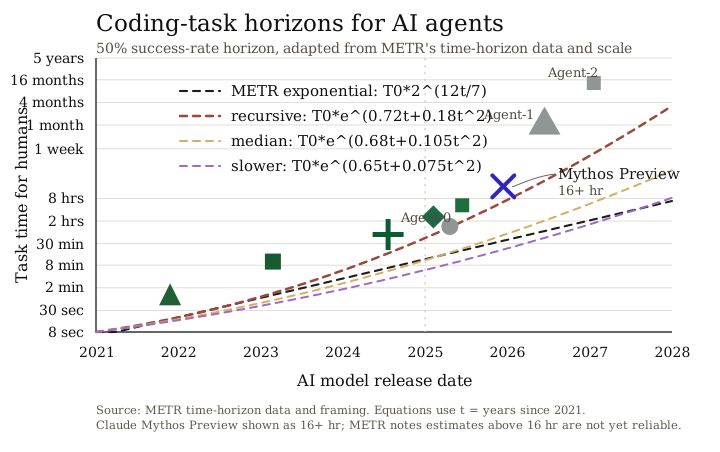
There is a new development that we are observing. As models learn how to train themselves, this equation is different. The scaling shifts into a hyper exponential. Essentially:
$I(t) = I_0 e^{\alpha t + \beta t^2}$
More qualitatively:
In the ordinary case, log-capability grows linearly with time. In the self improving future, log-capability grows superlinearly.
We can see this taking root already. GPT 5.5 and Claude Mythos–both of which had the training and research augmented with support from their predecessors–seem to lie on a hyper exponential.
What does this mean?
During the industrial revolution, manual labor went away, while the people that built the machines were durable. Here, the people building cutting edge models will be just as easily automated away: in fact, we are the job that we gain the most by automating. Here at OpenAI, it already feels like our latest models + harness are smarter than a sharp research intern. By the end of 2027, the models will likely be as good as a mid-career researcher. Where does this leave us?
Lee Sedol and Re-Framers
The strongest objection to this reading is that models do not automate humans, but they automate frames.
Models live in frames. A benchmark is a frozen world. A prompt is a frozen world. A job description is a frozen world. Give the model a frame and it may climb faster than any human. But someone still has to decide what world to freeze. Someone has to notice a benchmark is stale, a product feels dead, the UI or writing looks “samey” or “AI-slop”, the customer asked for the wrong thing, the rewrite should not happen, that the obvious research direction is saturated.
This is the optimistic theory of human durability: that operating within a frame is distinct from being a framer.
But this comfort is incomplete. Human ambition is organized around frames. Chess titles, research fields, internships, promotions, startups, papers, benchmarks, credentials–these are all ladders inside frozen worlds. If AI saturates frames faster than humans can climb and recurse up the levels, then the framer survives. But those who aimed to find success within a given frame will be left behind. And if “frame-building” becomes a frame in its own right, then the models may climb that as well–and where does that leave us?
The question is not whether humans remain metaphisically necessary. The question is whether human adaptation can stay economically and psychologically ahead of machine saturation.
I struggle to think how Lee Sedol felt when AlphaGo bet him.
Before Go was solved, it was thought that the strategy and cognition required to play made it impossible for machines, which had only succeeded through retrieval or other data/compute heavy approaches. AlphaGo was a remarkably consequential1, not least for proving that “uniquely human” tasks can often be handled by well trained model.
After watching that game, I made a private benchmark for AGI—if a generalist model with no task specific posttraining can beat alphago, we will have conclusively proven that the bitter lesson is correct and that they are strictly better as a result of the scale of data and compute.
If this is true, humans, which have a finite limit on context and training time, will never outperform the large omnimodels of the future on any in-distribution task. There is a niche bit of work where the problem space is out of distribution that we may have the edge in, but there is no empirics that tip the scales in our favor.
To Be New
I believe in putting in work that compounds. But in a post AI society where value is contingent soley on adaptability and continual learning, the more valuable investments are in general neuroplasticity, health, exposure, etc.
The consequences of AI and the knowledge substrates that will gain value as a result are a topic for another essay–I plan to write more on this topic in the near future. I’m not a cynic–there are still incredible things to be built for the forseeable future, and the labs are unlikely to build all of them. But the large scale automation of knowledge work will change the way we operate for the forseeable future, and it is important to acknowledge and explore that to its proper depth.
Epilogue: Morris Chang
In 1955, Morris Chang’s biggest decision was to work at Ford or a small Semiconductor company as a mechanical engineer. After bouncing around and eventually joining Texas Instruments, he started his work in a ASICs, a domain that was just getting off the ground.
In 1987, he left TI to go found TSMC, around age 56. Today, TSMC underpins the global semiconductor economy–when Morris was my age, semiconductors were barely more than a research prototype.
It goes to say–ambition is not obsolete, nor does the future belong only to those standing at the frontier. But ambition must remain liquid. There is a terror in watching Deep Blue climb faster than you, but conversely, when one game is broken the answer is not to keep playing it, but to find the right game early. Perhaps the goal isn’t to take the crown from Kasparov: more often than not, the real win is noticing that chess is no longer where history is made.
Watch the documentary if you haven’t. Consequential for far more than I can articulate. ↩︎